Waiting for a Steam sale is rational when you are not playing this week, the live price sits well above your tracked USD low, and your backlog already exceeds the hours you have. Buying now is rational when the current price matches your target, friends are active in a live-service title, or a confirmed play date arrives before the next likely discount window.
Direct answer
Use a five-signal framework before checkout: play timing, price versus tracked USD low, game age and discount rhythm, backlog pressure, and edition fit. Buy when you will install within the next month and the live price is at or below your tracked USD low for the exact SKU. Wait when the price remains far above that tracked low and you have no fixed play date. Set a Radar target at My Radar when you need a reminder instead of refreshing the store daily.
Five-signal decision framework
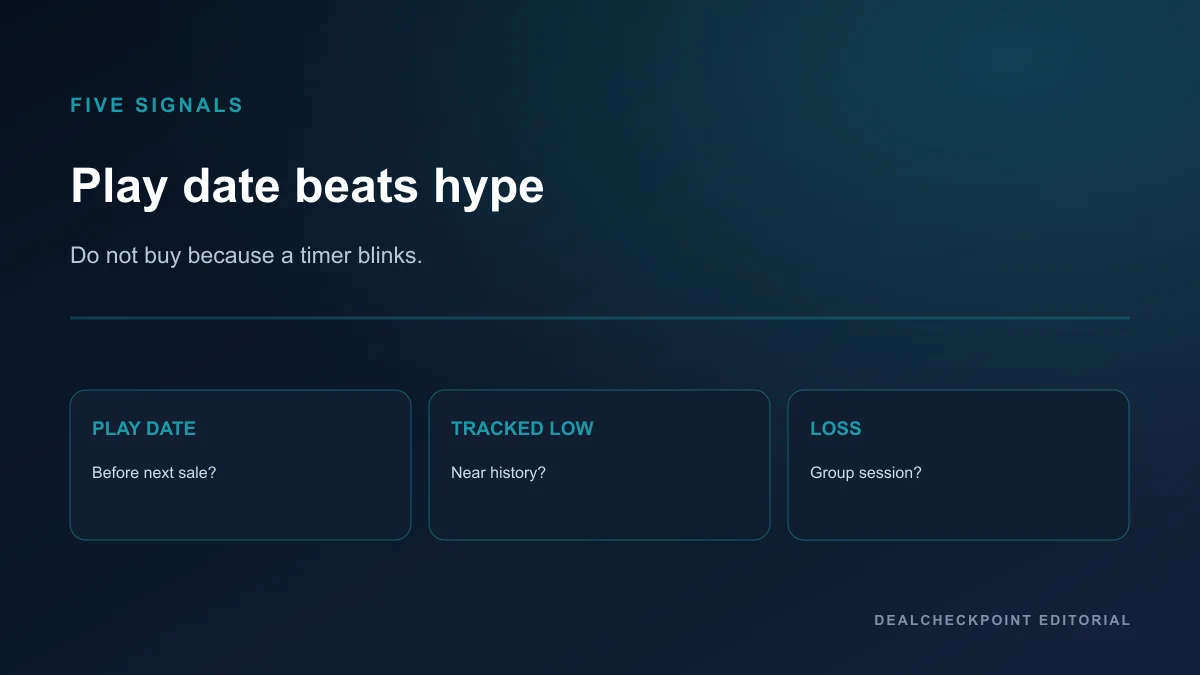
Signal 1 — Play timing
Will you start this game within the next 30 days? That 30-day window is a DealCheckpoint editorial heuristic — not a guaranteed pricing rule. If yes, a fair current price beats hypothetical future savings. If no, waiting costs nothing except patience.
Signal 2 — Price versus tracked USD low
Compare the live cart total for the exact edition against your tracked USD low. At or below that figure during an active promotion, lean buy if Signal 1 is also true.
Signal 3 — Game age and discount rhythm
Older single-player catalog titles often discount more predictably than launch-quarter releases in DealCheckpoint’s editorial experience — DealCheckpoint editorial heuristic — not a guaranteed pricing rule. Indies and early-access games can move faster than AAA narrative RPGs under the same heuristic.
Signal 4 — Backlog pressure
If unplayed owned games already exceed this month’s free hours, another discounted cart item adds guilt, not value — even at 70% off.
Signal 5 — Edition fit
Deluxe bundles with soundtracks you will never listen to, currencies you will never spend, or DLC you already own should wait for a base-game feature or a cleaner SKU.
Applying all five signals together
Strong buy posture requires Signals 1, 2 and 5 aligned: you will play soon, the price is at or below your tracked USD low, and the SKU matches what you need. Strong wait posture often pairs Signal 3 or 4 with a weak Signal 1: older catalog pricing still elevated while your backlog is full and you are not playing this month.
Tracked USD low definition
Tracked USD low: Lowest paid USD price recorded in DealCheckpoint's current comparison history across supported stores.
That figure is a comparison-history reference, not a promise that the price will return, not proof that every tracker agrees, and not a claim about every historical moment before DealCheckpoint tracked the SKU.
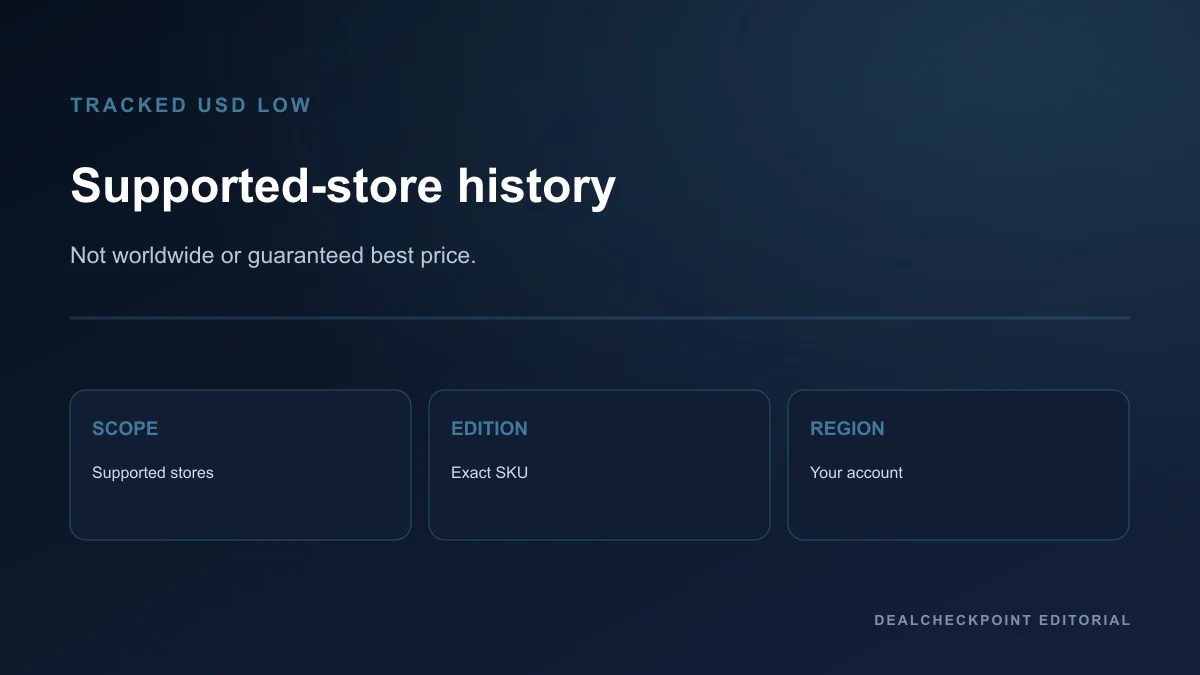
Always match edition, region and DRM before comparing numbers. A deluxe Steam SKU and a base Epic SKU are not interchangeable signals.
When waiting usually pays off
Waiting makes sense when:
- The live price remains well above the tracked USD low and you are not playing this week.
- The game launched within the last 90 days and no meaningful cut has appeared yet — DealCheckpoint editorial heuristic — not a guaranteed pricing rule.
- You want a deluxe edition mainly for cosmetic extras you could skip.
- Your backlog already contains similar unplayed titles.
- A major seasonal event is confirmed soon on the 2026 Steam sale calendar and you can wait without missing a fixed play plan.
Waiting never guarantees a lower price — publishers can hold lines, rotate features, or discount different editions.
Publisher features versus seasonal sales
Individual publisher weekend features can beat waiting for the next Steam seasonal event for one title — or undercut it the following week. No rule guarantees which wins. Compare the exact edition and local cart total when a publisher feature is live, then compare again during the next confirmed seasonal window on the 2026 Steam sale calendar.
Waiting only for Steam seasonals while ignoring a live publisher feature can make sense when the current price is still far above your tracked USD low. Buying during a publisher feature can make sense when Signal 1 is true and the price matches your target.
When buying now is reasonable
Buying now is reasonable when:
- The sale price is at or below the tracked USD low for the exact edition you need.
- Friends are active in a live-service title this week and waiting means playing alone.
- You have a fixed vacation or co-op weekend before the next likely sale window.
- The base game SKU matches your library gap and deluxe upsells add no real value.
- You verified system requirements and edition contents — not just a discount badge.
Decision matrix
The 30-day, 40-hour and 90-day values below are optional decision aids — DealCheckpoint editorial heuristics — not guaranteed pricing rules.
| Signal | If true… | Lean |
|---|---|---|
| Live price at or below tracked USD low | Strong value if you will play soon | Buy |
| Large discount badge but above tracked low | Marketing percentage, not proof | Wait |
| Release within 90 days (heuristic) | First deep cut may not arrive yet | Wait unless day-one play matters |
| Backlog above 40 hours unplayed (heuristic) | Another sale game adds pressure | Wait |
| Fixed play date within 30 days (heuristic) | Playtime beats hypothetical savings | Buy if edition fits |
| Deluxe extras you will not use | Paying for bundle filler | Wait for base SKU or cleaner bundle |
Game age and discount rhythm
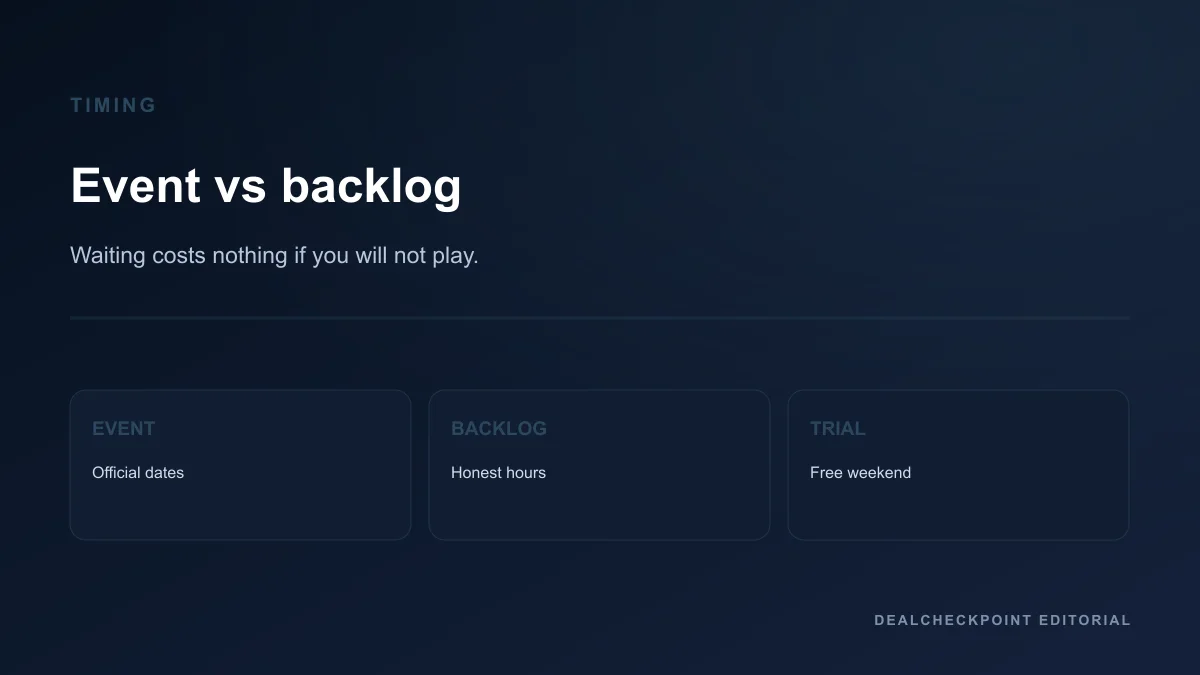
Launch-quarter AAA titles rarely match back-catalog lows immediately. Many narrative games may see a first meaningful cut around the first seasonal feature after launch in DealCheckpoint’s editorial experience — DealCheckpoint editorial heuristic — not a guaranteed pricing rule. Publisher participation varies.
Indies and early-access projects can discount within weeks. Live-service battle passes punish waiting when your squad is active now — compare season timing, not only MSRP history.
Waiting six months on a single-player RPG you are not playing this month is usually rational. Waiting six months on a seasonal event your group plays tonight is not.
Backlog honesty check
Count unplayed hours, not unplayed purchases. If you already own three 40-hour RPGs untouched, a fourth at 75% off is not automatically smart — DealCheckpoint editorial heuristic — not a guaranteed pricing rule.
Waiting keeps cash flexible for the one game you will actually launch. Use My Radar to track the title you truly intend to play first.
Edition and bundle checks
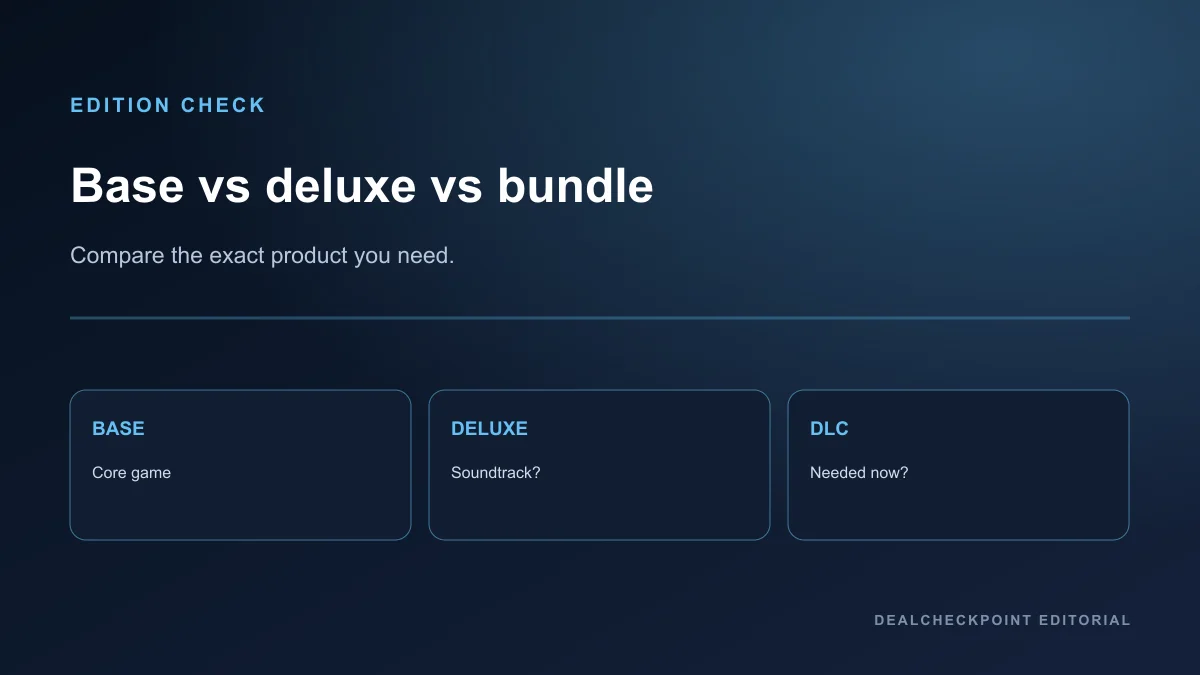
Before any sale purchase, confirm:
- Base vs deluxe vs complete — name the exact AppID-level product.
- Included DLC — mark what you already own.
- Soundtracks and cosmetics — strip items with zero personal value.
- Bundles — combined playtime limits apply to Steam bundle refunds; read the Steam refund policy guide before treating bundles as risk-free experiments.
The Steam sale survival guide walks through checkout discipline during active events.
Refund policy reminder
Steam’s common guideline for games is a request within 14 days of purchase and under two hours of playtime, but eligibility is evaluated per purchase type and Valve lists separate rules for DLC, bundles and other products.
Refunds are purchase-risk protection, not a pricing strategy. Valve may restrict access when it identifies abuse. Read the live policy on Steam Support before relying on any refund path — and never treat refunds as a substitute for checking edition, requirements and tracked USD low before checkout.
Expected play date test
Ask: Will I start before the next likely sale window? If yes, a fair current price often beats waiting. If no, waiting preserves budget for the game you will actually open.
Pair this test with Signal 1 in the five-signal framework rather than using countdown timers alone.
Wishlist discipline and Radar targets
Add the exact SKU to your Steam wishlist for visibility, then set an edition-matched target in My Radar with your tracked USD low reference. Wishlist notifications tell you something changed; Radar targets tell you your threshold arrived.
Review wishlist clutter before major seasonals — remove deluxe SKUs you never intended to buy so notifications stay actionable.
Steam sale vs Game Pass access
Subscription access through PC Game Pass and purchased Steam copies solve different problems. If you need a permanent library copy, compare the sale price against how many months of Game Pass you would pay while playing — then read PC Game Pass explained and Is PC Game Pass worth it in 2026? for access versus ownership math.
If a title may leave Game Pass soon and you want to keep it, a Steam sale near your tracked USD low can be rational even while subscribed.
Worked examples (illustrative)
- Three-year-old RPG at $44.99 with a tracked USD low near $14.99 during a non-sale week → wait for the next seasonal feature unless you are starting tonight.
- Co-op shooter your squad plays weekly already 35% off with an active season → buying now can beat waiting for an uncertain extra 10%.
- Deluxe edition with soundtrack you will never open → wait for a base-game feature or buy the standard SKU instead.
- Live price matches tracked USD low during a seasonal event and you will play this weekend → buy after edition verification, not because the banner ends in six hours.
- Year-old indie at $19.99 with tracked USD low near $9.99 during a non-sale week → wait unless you will stream it to friends tomorrow.
- Friend group owns a co-op title on Steam already and the current cart is within 10% of tracked USD low → buying now beats waiting for an uncertain extra cut.
Cross-store comparison
When a PC title sells on multiple stores, compare the same edition on Epic and GOG where available. Waiting only on Steam ignores legitimate wins elsewhere — but each store’s refund and ownership rules differ.
Use the real PC game deal guide before treating any third-party headline percentage as proof of value.
New release wait discipline
Launch-quarter titles often sit above tracked USD lows because the comparison history is short. Waiting makes sense when Signal 1 is weak — you are not playing immediately — and Signal 3 is strong because the release is recent. Buying at launch MSRP on Steam rarely beats patience unless you have a fixed co-op or review plan that cannot slip.
Read should you preorder PC games? for launch-week purchase discipline separate from sale waiting.
When a title is new to DealCheckpoint’s comparison history, treat the tracked USD low as a young reference — useful, but based on fewer observations than a five-year catalog game.
Frequently asked questions
Should I wait if a sale ends in six hours?
Only if the current price is still above your tracked USD low target. Many Steam seasonal discounts persist for the full event — timer theatre is not proof the price will rise tomorrow.
Does a 70% badge mean it is a good deal?
Not automatically. Compare against the tracked USD low for the exact edition. Large percentages above that reference are marketing, not proof.
Should I buy just to try the game and refund later?
No. Steam refunds are limited purchase-risk protection with eligibility rules and abuse restrictions — not a trial workflow. Use demos, free weekends and research when available instead of planning around refund boundaries.
Does Epic or GOG change the answer?
Cross-store exclusives aside, compare the same edition on other supported stores when multi-store keys exist. Waiting only on Steam ignores legitimate wins elsewhere.
What if the game is on Game Pass?
Access while subscribed is not the same as a Steam library copy. Compare subscription months against a sale near your tracked USD low if you want permanence.
Where do I track targets?
Set edition-specific targets in My Radar and browse live records through the PC deals hub.
How close is close enough to tracked USD low?
There is no universal tolerance band. If you will play this week and the live price matches your tracked USD low for the exact SKU, lean buy. If you are not playing and the price sits meaningfully above that reference, lean wait.
Should I wait for every seasonal sale?
No. Seasonals are timing tools, not automatic deeper cuts for every title. Use Signals 1–5 on the product you actually want.
Final summary
Wait when you are not playing this week, the live price sits above your tracked USD low, and your backlog already exceeds available hours. Buy when the exact edition matches your library gap, the price is at or below that tracked reference, and you can name when you will install. Use the five-signal framework, verify editions before checkout, and treat Steam refunds as cautious purchase-risk protection — not a substitute for disciplined sale shopping.
Game images are official promotional or store assets belonging to their respective publishers and are used for editorial identification and commentary. DealCheckpoint does not claim ownership of publisher artwork.