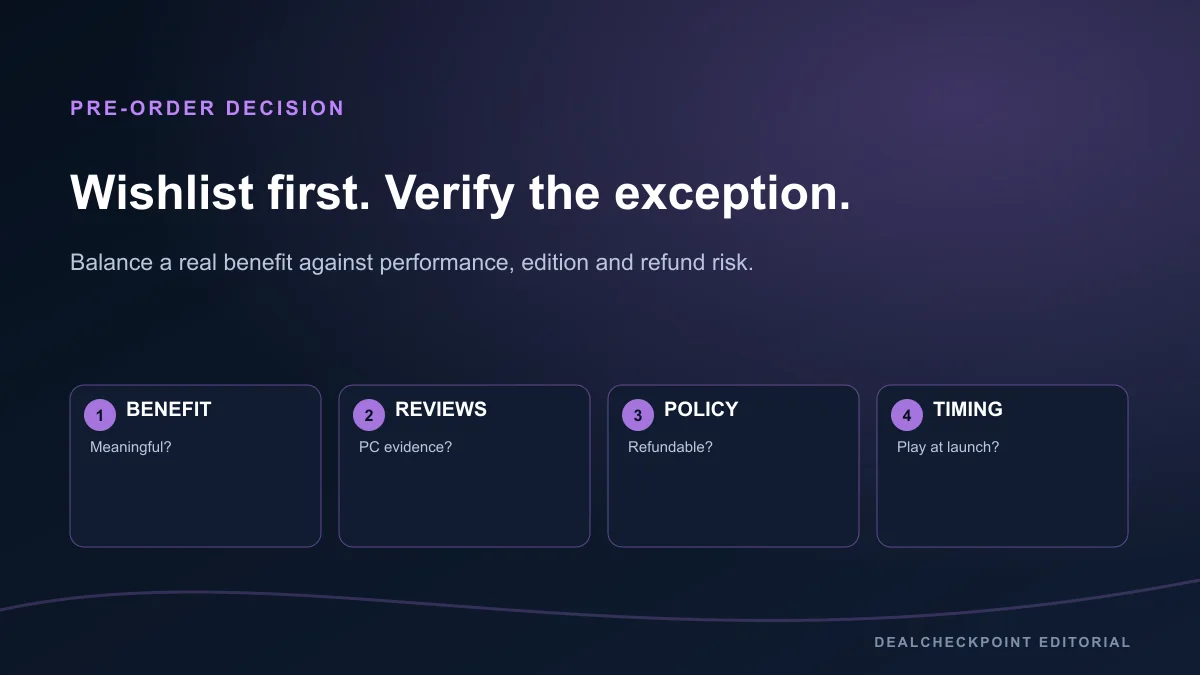
For an ordinary digital PC release, wishlist first and wait for independent technical coverage. Pre-order only when a specific, verifiable benefit matters to you, the exact edition and system requirements are clear, you will play at launch, and the point-of-purchase refund policy gives protection you understand. Limited physical stock can change the decision; unlimited digital inventory usually does not.
Direct answer
Most digital PC buyers lose nothing by waiting until release-day performance, server and edition facts are visible. A pre-order can still be reasonable for a genuinely limited collector’s edition, a meaningful bonus, a modest launch discount under a verified refundable policy, or a player definitely starting at launch. It is not reasonable because a timer creates urgency, a cosmetic has no stated later availability, or a third-party key costs slightly less but cannot be refunded through the platform.
| Decision | Conditions||Wait | No independent PC performance evidence, unclear requirements, confusing editions or no day-one play plan||May be reasonable | Known requirements, meaningful benefit, verified refund path and immediate launch plan||Skip | Non-refundable key, account listing, VPN activation, consumable-heavy bundle or unknown seller||Pre-order physical | Limited stock is real and the retailer cancellation terms are acceptable |
|---|
The default recommendation
Wishlist the game, follow its official requirements and release page, then read independent PC technical coverage when available. This keeps the option to buy while reducing exposure to shader stutter, driver issues, unstable servers, misleading edition names and bonuses that are smaller than expected. Use the twelve-check PC deal test before any discounted pre-purchase.
The default is not a universal ban. It is a low-cost starting position for digital inventory that is not scarce. Change it only when a concrete benefit outweighs missing information.
When pre-ordering may make sense
- A physical collector’s edition has genuinely limited production and you accept the retailer’s cancellation terms.
- A named bonus has clear personal value and its platform or edition is correct.
- A launch discount is meaningful, the purchase remains refundable under a checked policy, and you will start immediately.
- The developer has published transparent PC requirements and relevant technical information.
- You know the store, edition, activation platform and region.
- You can monitor runtime and request a refund within the actual policy if the launch is unacceptable.
Developer reputation can reduce uncertainty but never guarantees a technically sound release. Treat prior work as context, not refund protection.
When to wait
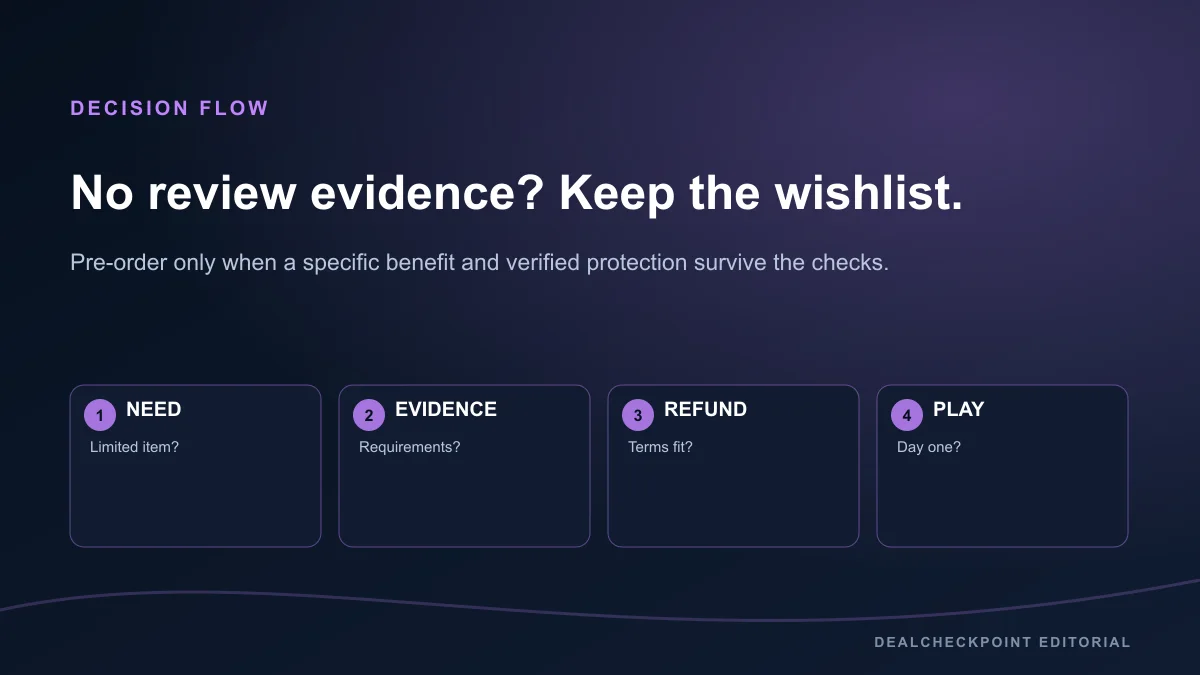
Wait when there are no PC performance reviews, requirements are missing or vague, the game is always online, editions are difficult to compare, advance-access time counts toward a runtime limit, the bonus is minor cosmetics, or you will not play at launch. Also wait when a third-party key retailer cannot explain cancellation before delivery and refund after activation.
A wishlist is useful here: it preserves the reminder without moving money before the evidence exists. Check the upcoming-games hub and sale calendar instead of treating a preorder countdown as the only buying window.
The digital scarcity myth
A standard digital license normally has no manufacturing stock to exhaust. Stores can stop sales or change bonuses, but the ordinary base game does not need to be reserved like a numbered physical item. “Pre-order now” is therefore a timing choice, not a guarantee of access.
Physical collector’s editions are different because statues, steelbooks and boxed components can have finite production. Verify the seller, shipping region, contents, cancellation deadline and whether payment is taken immediately.
Pre-order bonuses
List the bonus in plain language: cosmetic skin, mission, currency, soundtrack, early unlock or real discount. Ask whether it affects the full game, can be earned later, is tied to a specific edition, or is consumed on use. A bonus that you would not buy separately has little monetary value.
Do not assume “exclusive” means permanent. Use the publisher’s exact wording. If availability after launch is not stated, mark it unknown rather than creating urgency.
Early access and advance access
Marketing labels can hide an important distinction. Steam says playtime in Early Access or Advance Access counts against the two-hour refund limit, while beta testing is treated differently in its pre-release explanation. Epic says early-access or beta pre-purchases need less than two hours of runtime for a refund.
If a deluxe edition sells several days of advance access, decide how much of that window you might play before discovering technical problems. A runtime clock can reduce practical refund protection even before the standard release date.
Review embargoes
An embargo is the time a publisher allows reviews to appear. A late embargo does not prove a bad game, but it leaves less independent evidence before launch. Check whether PC code was reviewed, whether performance measurements cover hardware similar to yours, and whether online servers were available.
Creator sponsorships, publisher previews and reviews can all be useful when clearly labeled, but they answer different questions. Prioritize independent technical evidence for a PC purchase decision.
PC performance and shader or driver risk
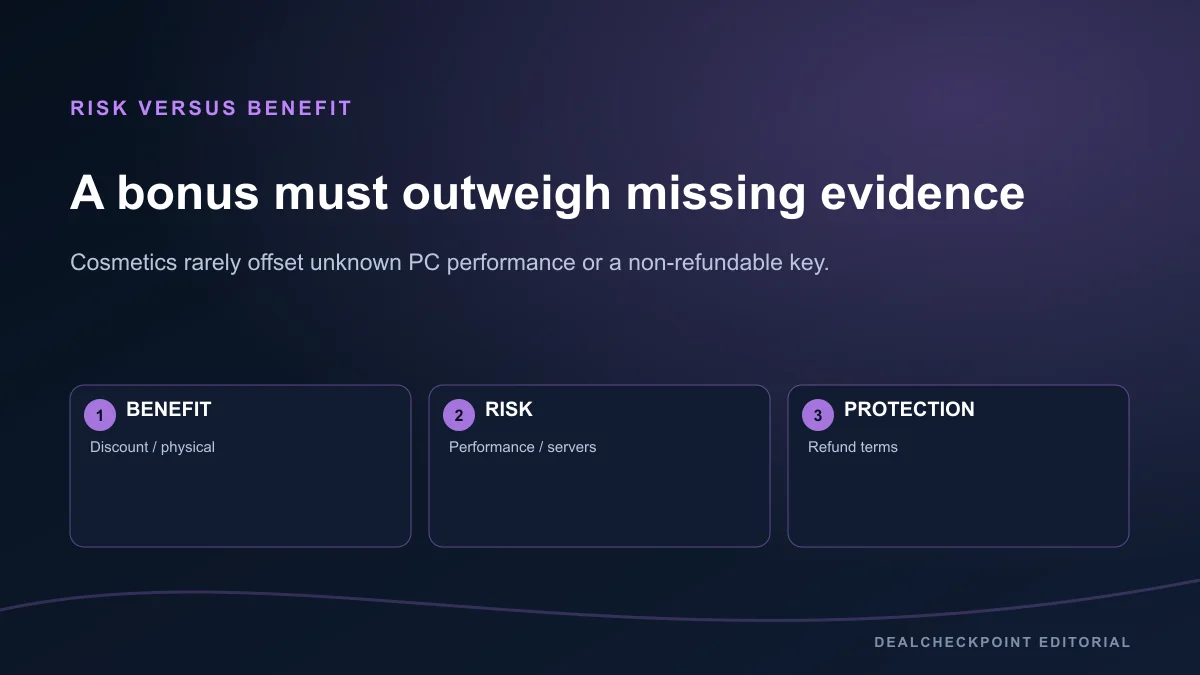
PC releases span many CPUs, GPUs, drivers, storage devices and operating-system states. Risks include shader-compilation stutter, traversal stutter, memory leaks, unstable frame pacing, broken ultrawide support and launch-day driver issues. No store badge can guarantee performance on your exact machine.
Look for frame-time evidence, not only average frame rate. Confirm the tested build and patch. A day-one update can improve or worsen results, so recheck after release when performance is the deciding factor.
System requirements
Read minimum and recommended requirements on the official product page and publisher site. Minimum can mean only that the game starts; it may not state the resolution, quality preset or frame-rate target. Recommended requirements also need a stated target to be useful.
Check storage type and free space, CPU generation, GPU memory, operating system, online account and anti-cheat requirements. Compare the exact PC edition, because a console page or old beta requirement does not establish current PC compatibility.
Editions and DLC
Build a small list for Standard, Deluxe and higher editions. Mark the base game, expansions, cosmetics, currency, soundtrack, battle pass and advance-access period. Then price only the extras you genuinely value. “Deluxe” and “Ultimate” are publisher labels, not consistent content standards.
Released content inside a pre-purchase bundle can change refund treatment. Epic’s current policy applies less than two hours of runtime across products in an eligible pre-purchased bundle and warns that virtual currency or consumables can make a bundle non-refundable. Read the checkout label.
Store-by-store refund matrix
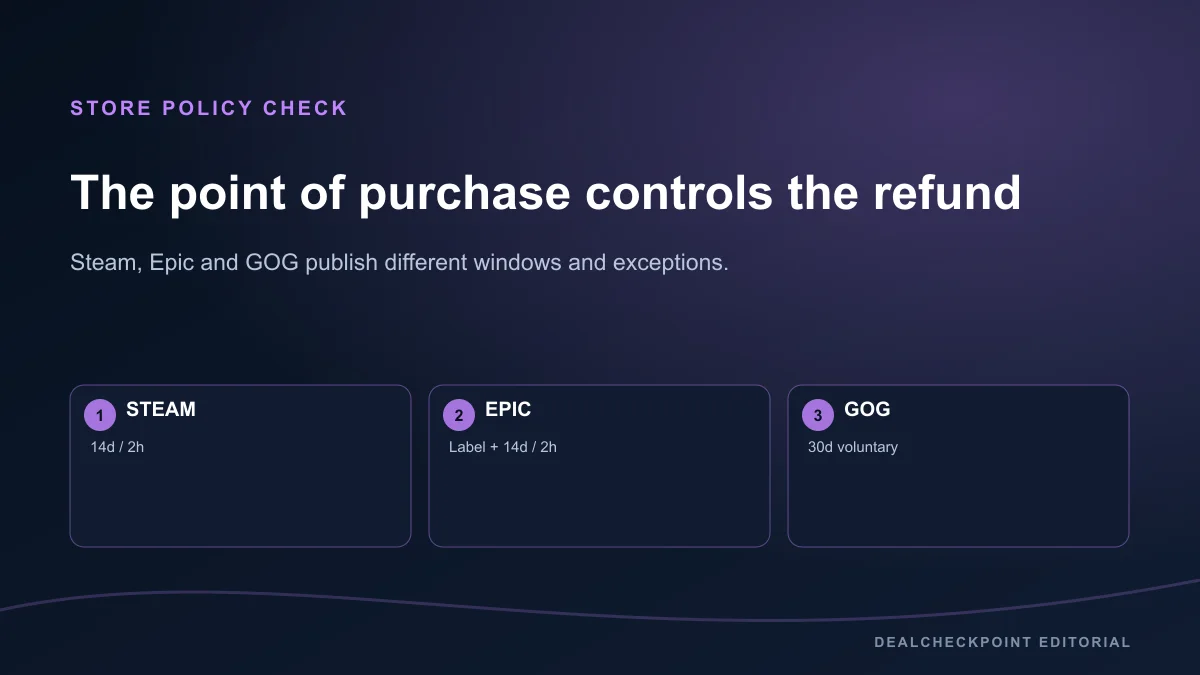
| Store | Can cancel before release? | Post-release window | Runtime limit | Early or advance access | Important exception | Official policy||Steam | Yes for a non-playable pre-purchase before release | Standard period starts at release: 14 days | Less than 2 hours | Runtime counts except beta testing | Steam cannot refund third-party keys | Steam Refunds||Epic Games Store | Self-refundable pre-purchases can be refunded before release | Eligible PC or Mac product: 14 days after release | Less than 2 hours | Early access and beta runtime count | Product label and consumables can make it non-refundable | Epic refund policy||GOG | Refundable throughout the pre-order period | Voluntary policy says 30 days after release | No fixed runtime cap stated on this policy page | Early Access uses the 30-day purchase window | GOG can refuse abuse and packs may be removed as a whole | GOG refund policy |
|---|
Policies were checked July 22, 2026. Eligibility is not guaranteed merely because a request falls inside a headline window; exceptions, abuse controls, local law, product labels and point of purchase matter. Microsoft/Xbox is omitted from this matrix because its current dynamic support page could not be fully source-verified in this publication pass.
Third-party key retailer risk
A key seller is the point of purchase even when the code activates on Steam or another platform. Steam explicitly says it cannot refund CD keys purchased outside Steam. Check whether the retailer allows cancellation before key delivery, what happens after a key is revealed, and whether the product region and edition are exact.
Do not buy an account. Do not accept VPN activation or a request to change the account country. An authorised retailer can still have stricter key-refund terms than the platform store.
Collector’s editions and physical stock
Physical scarcity can be a valid reason to reserve, but the box creates new questions: shipping cost, import tax, platform, disc or code format, regional activation, damaged-item process and cancellation before dispatch. Confirm whether the PC version contains a disc, a key, or only collectibles.
A deposit or immediate charge can affect cancellation. Use the retailer’s current order terms, not the digital storefront matrix above.
Multiplayer launch risk
An online game can have adequate local performance and still fail at matchmaking, queues, authentication, progression or cross-play. Pre-launch tests use limited populations and do not guarantee launch capacity. Check server regions, party size, required accounts and whether solo modes depend on servers.
A friend group’s launch plan can be a real benefit, but coordinate the same edition and platform. Do not rely on cross-play or cross-progression without current official confirmation.
A decision checklist
- Name the exact edition, activation platform and region.
- Write the specific benefit that would be lost by waiting.
- Confirm current official system requirements and available PC technical evidence.
- Read the point-of-purchase cancellation and refund policy, including runtime.
- Check whether advance access, released bundle content or consumables change eligibility.
- Confirm that a third-party key is refundable by that retailer rather than the platform.
- Decide whether you will start at launch and set a runtime reminder.
- If any critical answer is unknown, wishlist and wait.
Three buyer scenarios
Scenario A: single-player AAA release with no PC reviews
Recommendation: Wait. Digital stock is not the issue, and the missing PC evidence matters more than a cosmetic bonus. Keep the wishlist and review requirements, frame-time coverage and launch patch results.
Scenario B: refundable Steam pre-order with a modest launch discount
Recommendation: May be reasonable, but not necessary. This fits a player definitely starting at launch after verifying requirements and monitoring the two-hour limit. Advance Access runtime counts, so do not treat the window as an unrestricted trial.
Scenario C: non-refundable third-party key with a cosmetic bonus
Recommendation: Skip. The minor bonus does not compensate for the missing platform refund path and key-retailer restriction. Wait for technical evidence or buy later from a point of purchase with acceptable terms.
FAQ
Are PC game pre-orders always bad?
No. A limited physical edition or a meaningful refundable launch offer can fit a specific buyer, but ordinary digital purchases usually gain information by waiting.
Can I refund a Steam pre-order after playing Advance Access?
Steam says Advance Access playtime counts toward the two-hour limit. The standard fourteen-day period begins at release, subject to the current policy details.
Does Epic refund every pre-purchase before release?
No blanket promise applies. Epic distinguishes self-refundable, refundable and non-refundable products, and consumables or virtual currency can change eligibility.
Does GOG have a two-hour runtime limit?
The current voluntary policy page states a thirty-day request window and does not state a fixed two-hour cap, but GOG reserves the right to refuse abuse or limit the refund method.
Is a launch discount a good enough reason to pre-order?
Only when the amount matters, the edition and requirements are clear, the refund policy fits, and you will play at launch. A percentage alone is not enough.
Final verdict
For ordinary digital PC releases, wishlist first and wait for independent technical coverage unless a specific, verified benefit outweighs the uncertainty. Pre-ordering can be reasonable for limited physical stock or an immediate-play plan protected by clear store terms; it is weak when the reward is minor cosmetics, the PC build is unknown or the purchase is a non-refundable key. Track the launch through the upcoming-games hub, review the Steam sale timing guide, and set a target in My Radar instead of paying early by default.