Some free-to-play games sell presentation only; others sell time, inventory, characters, content, account services, or power. “Pay-to-win” is useful only after you define the activity being judged. A purchase can be harmless in a solo story, important to progression, and unacceptable in ranked competition at the same time.
Direct answer
Do not ask only whether a game is pay-to-win. Ask what can be bought, whether it changes combat options or statistics, how much time it saves, whether content is gated, whether rewards are random, and whether paying changes the competitive pool. Then judge the specific mode you intend to play.
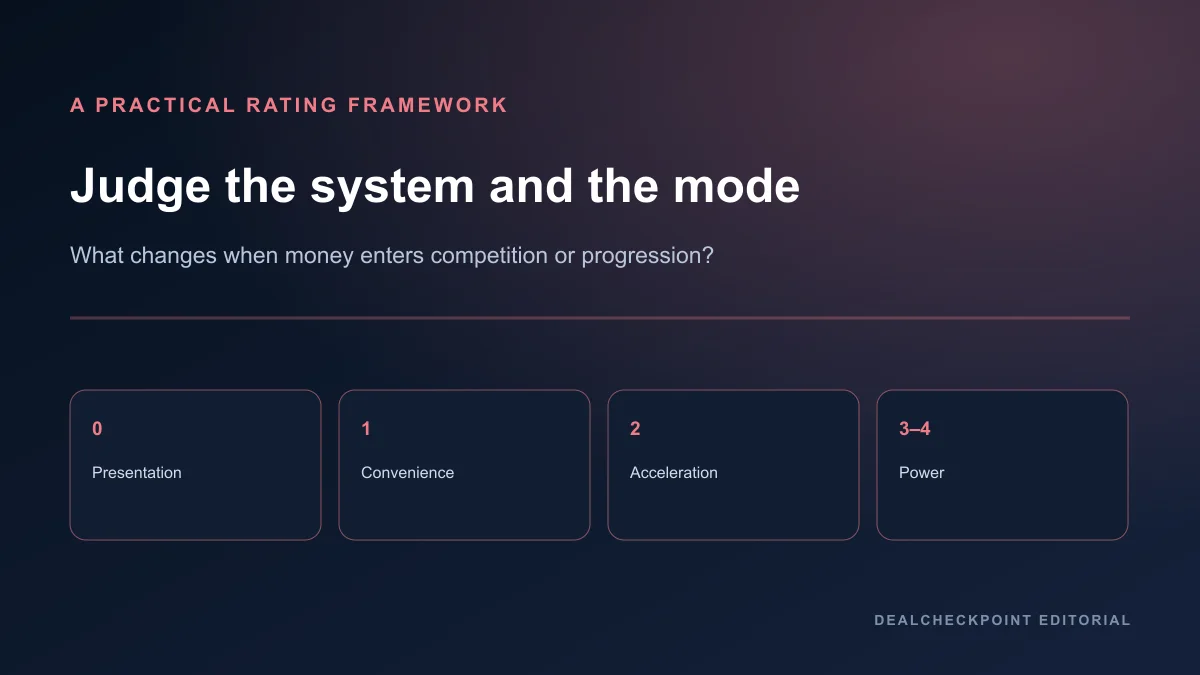
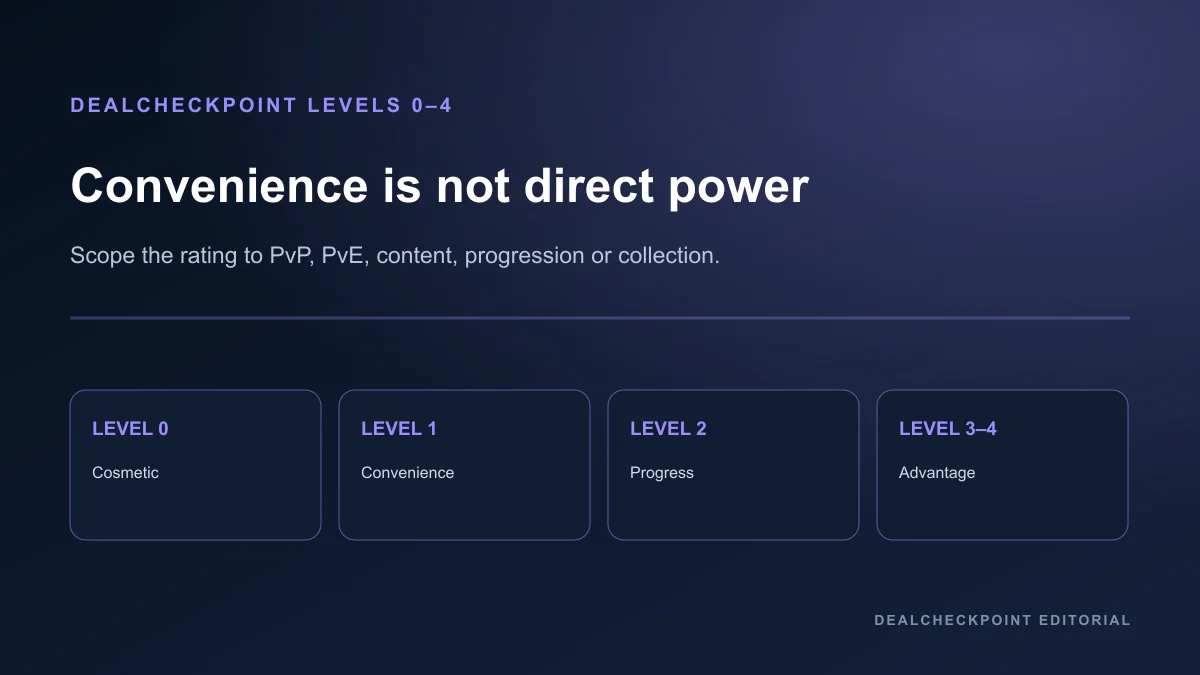
DealCheckpoint uses a five-level editorial framework: Level 0 for presentation, Level 1 for convenience, Level 2 for progression acceleration, Level 3 for purchasable gameplay advantage, and Level 4 for direct competitive power. This is not an official industry standard, and a game can contain systems at several levels.
The framework is a fit for comparing a named purchase system in a defined mode. It is not a fit for declaring every player’s experience fair or unfair, predicting future shop changes, or replacing the official store and probability disclosures.
What pay-to-win means
Pay-to-win means a purchase creates a meaningful advantage in the evaluated competitive outcome. That definition requires a scope: ranked PvP, casual PvP, cooperative endgame, solo progression, collection, or access to content. Faster progress is not automatically a match-winning advantage, but it can become one when progression feeds competitive stats.
Pay-for-power means money can acquire stronger characters, weapons, statistics, upgrades, or equivalent gameplay capability. Pay-to-progress-faster means money reduces the time or resources needed to reach a state that play can also reach. Pay-for-convenience reduces friction such as storage, loadout slots, timers, or repetitive management.
Pay-for-content gates expansions, campaigns, classes, maps, or activities behind a purchase. Cosmetic-only should be reserved for a specific system whose paid products change presentation without changing gameplay access, information, timing, or capability. It should not be applied to a whole game that also sells convenience or content.
Gacha is a randomized acquisition system in which a player spends currency for a chance at characters or items, usually with published probabilities and guarantee rules. A gacha can sell power, collection, or both. Randomness and power must be evaluated separately.
The monetisation spectrum
| Level | Editorial label | What payment changes | Key question |
|---|---|---|---|
| 0 | Cosmetic presentation | Appearance, animation, sound or profile display | Does the product alter no gameplay capability or information? |
| 1 | Convenience | Storage, organization, analytics, roster speed or service friction | Could saved friction affect preparation or choice? |
| 2 | Progression acceleration | Time, resources, crafting, levels or account development | Does payment reach gameplay states faster? |
| 3 | Purchasable gameplay advantage | Characters, weapons, upgrades or strong options | Can money acquire capability that matters in the evaluated mode? |
| 4 | Direct competitive power | Stats or effects that decide player-versus-player outcomes | Can a spender enter competition with a paid mechanical advantage? |
The rating records the highest material paid effect in the stated scope, not a moral score for the whole game. Level 3 in a cooperative game does not imply Level 4 ranked PvP. Level 1 can still be unacceptable to a player who values equal preparation.
Players reasonably disagree about the boundary between convenience and power. Extra storage can look administrative to a beginner and essential to an endgame trader. The correct response is to document the effect and let the reader decide whether that effect violates their standard.
Cosmetic-only systems
A cosmetic purchase changes how something looks or sounds without adding combat statistics, content access, hidden information, or faster progress. Even then, inspect readability: a visual effect that obscures information or resembles another ability can create a competitive concern despite having no stated stat bonus.
Do not call a game cosmetic-only merely because its most visible shop products are skins. Counter-Strike has keys, cases, Prime-related systems, and a secondary market. Dota 2 has Dota Plus. Path of Exile has stash tabs. The specific cosmetic catalog may be Level 0 while the broader purchase model reaches another level.
Convenience and inventory
Convenience sits at Level 1 when payment reduces friction without directly purchasing the evaluated power state. Path of Exile stash tabs are the clearest case here: specialized storage and organization can make trade and endgame inventory easier, even though a tab does not add damage to a character.
Inventory slots, loadout slots, crafting queues, automatic collection, market access, and analytics deserve separate notes. The more often a player hits the limitation, the more meaningful the convenience becomes. A one-time annoyance and a permanent endgame bottleneck should not receive the same description.
Progress acceleration
Level 2 covers purchases that shorten a progression path: materials, boosts, premium currency, instant crafting, character levels, or resource packs. Lost Ark’s official shop has sold subscriptions, currencies, honing materials, cards, and progression-support packs. Warframe’s official shop says Platinum can buy upgrades, boosts, weapons, and Warframes.
Acceleration can affect competitive fairness when progression controls PvP statistics or access. In a cooperative or primarily PvE context, the same purchase may change pacing and group readiness rather than directly defeating another player. State which mode is being judged.
Gacha and randomised acquisition
Randomized acquisition adds budget risk because the cost of a desired result is uncertain until the guarantee rules are considered. Record the probability, guarantee or pity rule, duplicate effects, currency price, and whether the acquired character or item affects gameplay.
Genshin Impact’s official Wish system publishes probability and guarantee details for characters and weapons. Characters, weapons, Constellations, and Refinements can change combat capability, so the relevant system reaches Level 3 for PvE power. Genshin is not a ranked PvP case study here; the rating does not claim direct competitive power.
Loot boxes and cases can also be randomized without selling combat power. Counter-Strike weapon finishes are presentation items with market value, but paid keys and random outcomes still create spending and gambling-like risk. Randomness is a consumer issue even when the reward is cosmetic.
Paid content and expansions
Pay-for-content is different from pay-for-power. A paid expansion can gate a campaign, class, raid, or equipment pursuit without making a purchaser stronger inside every shared mode. The purchase still matters because non-buyers cannot access the same content.
Destiny 2 is a useful example outside the seven detailed ratings: Bungie documents free activities alongside paid expansions, content packs, Dungeon Keys, and rewards products. Calling the game fully free would erase those boundaries; calling every expansion pay-to-win would ignore the difference between access and competitive power.
Competitive versus PvE impact
Competitive impact depends on matchmaking and the rule set. A paid matchmaking pool, premium queue, roster unlock, statistical upgrade, information tool, or progression boost can matter differently in ranked PvP than in solo play.
In PvE, power purchases can still affect group expectations, progression speed, and social pressure. The absence of PvP does not make spending irrelevant; it changes the harm being measured. Use Level 3 for purchasable gameplay capability and reserve Level 4 for direct paid power in the evaluated competition.
Trading and secondary markets add another layer. Counter-Strike and Team Fortress 2 items can carry market prices, while Warframe supports player trading for eligible items. A tradable economy can let time substitute for money, but it can also expose players to speculation, scams, and price volatility.
Seven game case studies
| Game and scope | What can be bought | Combat power | Acceleration | Paid content | Randomised purchases | Competitive impact | DC level |
|---|---|---|---|---|---|---|---|
| Dota 2 — standard matchmaking | Cosmetics, event products, Dota Plus subscription | No direct hero-stat purchase identified | Analytics and service convenience | No hero purchase required in the evaluated roster | Some cosmetic/event reward systems vary | Dota Plus information may help preparation but does not add hero stats | Level 1 |
| Counter-Strike 2 — competitive context | Prime-related access, keys, cases, skins and market items | Weapon finishes do not add weapon stats | Prime changes account/matchmaking and reward context | No campaign scope evaluated | Cases produce random cosmetic outcomes | Prime changes pool/context, not mechanical weapon power | Level 1 |
| Path of Exile — trade/endgame PvE | Stash tabs, cosmetics and supporter packs | Tabs do not add character damage | Storage and public trade convenience can be substantial | Core app is free entry | Mystery-box products can be random | Trade dependence can make convenience economically meaningful | Level 1 to 2 by trade dependence |
| Warframe — PvE progression | Platinum, Warframes, weapons, boosts, slots and cosmetics | Weapons and Warframes are gameplay capability | Money can bypass grind and timers | Updates and quests are not classified as paid expansions here | Some packs/reward systems vary | Main scope is cooperative PvE, not direct ranked power | Level 2 to 3 by purchase |
| VALORANT — competitive roster and cosmetics | Weapon skins, bundles, battle pass, paid Agent unlocks and Game Pass access | Skins do not state combat-stat bonuses | Payment or a linked subscription can provide Agent access sooner | Maps and standard competition are not sold as expansions | Rotating visible offers are not classified here as gacha | Earlier roster access changes strategic options, while weapons keep standard stats | Level 2 |
| Genshin Impact — PvE combat | Random Wishes for characters/weapons, currency and pass products | Characters, weapons and duplicate upgrades affect capability | Payment can accelerate roster and account power | Major world updates are free, some products add resources | Yes, with published probability/guarantee rules | No ranked PvP scope evaluated | Level 3 |
| Lost Ark — PvE/MMO progression | Currencies, Aura subscription, materials, cards, services and cosmetics | Some subscription feast choices grant temporary PvE combat stats | Yes, shop products sell XP and progression materials | Base app is free entry | Some card/item acquisition systems include chance | Can affect PvE raid readiness and power, not classified as direct PvP power here | Level 2 to 3 by purchase |
Dota 2
Valve’s official Dota Plus page describes a paid monthly service with hero progression, assistant suggestions, analytics, Battle Cup access, and rewards. DealCheckpoint classifies those paid service and information features as Level 1 in standard matchmaking. The purchase does not add stated hero statistics, but players may reasonably view real-time suggestions as more than presentation. Source checked July 22, 2026. Dota 2 game page.
Counter-Strike 2
Counter-Strike sells Prime Status-related access, cosmetic inventories, cases, keys, and market-traded items. Weapon finishes are Level 0 presentation; Prime’s matchmaking/reward context and account service effect raise the evaluated system to Level 1. Case rewards are randomized and can carry market value, but this review found no official claim that a skin changes weapon damage. Source checked July 22, 2026. Counter-Strike 2 game page.
Path of Exile
Grinding Gear Games sells cosmetics, supporter products, and specialized stash tabs. Premium public tabs streamline listings on the official trade site, so the endgame/trade scope reaches Level 1 and can reach Level 2 where economic efficiency is central to the player’s progression. The review does not classify a stash tab as combat power, and players may reasonably draw the convenience boundary differently. Mystery-box details must be checked when a current box is offered. Source checked July 22, 2026. Path of Exile game page.
Warframe
Digital Extremes says Platinum buys enhancements including upgrades, boosts, weapons, and Warframes. Some equipment can also be acquired through play or trading, but that does not erase the paid shortcut. DealCheckpoint rates routine acceleration as Level 2 and direct purchase of gameplay-capable equipment as Level 3 in PvE progression; it does not label Warframe Level 4 competitive pay-to-win. Source checked July 22, 2026. Warframe game page.
VALORANT
Riot sells weapon cosmetics, bundles, and battle-pass products. Its official progression guidance says VP can immediately unlock an Agent during recruitment, while an active linked Xbox Game Pass membership provides access to Agents during the subscription. Standard weapon skins do not advertise combat-stat bonuses. DealCheckpoint rates earlier strategic roster access as Level 2 acceleration/options even though cited sources show no paid gun-stat increase. Source checked July 22, 2026. VALORANT game page.
Genshin Impact
HoYoverse’s Wish rules describe randomized character and weapon acquisition with published probabilities and guarantees. Characters, weapons, Constellations, and Refinements can change PvE combat capability, so this system is Level 3. The article does not claim that paying is required to finish a defined piece of content and does not substitute an unsupported claim about starter characters for evidence. Source checked July 22, 2026. Genshin Impact game page.
Lost Ark
Amazon Games’ current shop lists currencies, Crystalline Aura subscriptions, honing materials, cards, and progression packs. Its subscription page also lists temporary feast choices with explicit weapon-power or other combat-stat effects. DealCheckpoint therefore rates acceleration as Level 2 and those direct PvE effects as Level 3; this is not a finding that every purchase affects power or that the game sells direct ranked PvP victory. Source checked July 22, 2026. Lost Ark game page.
Warning signs before installing
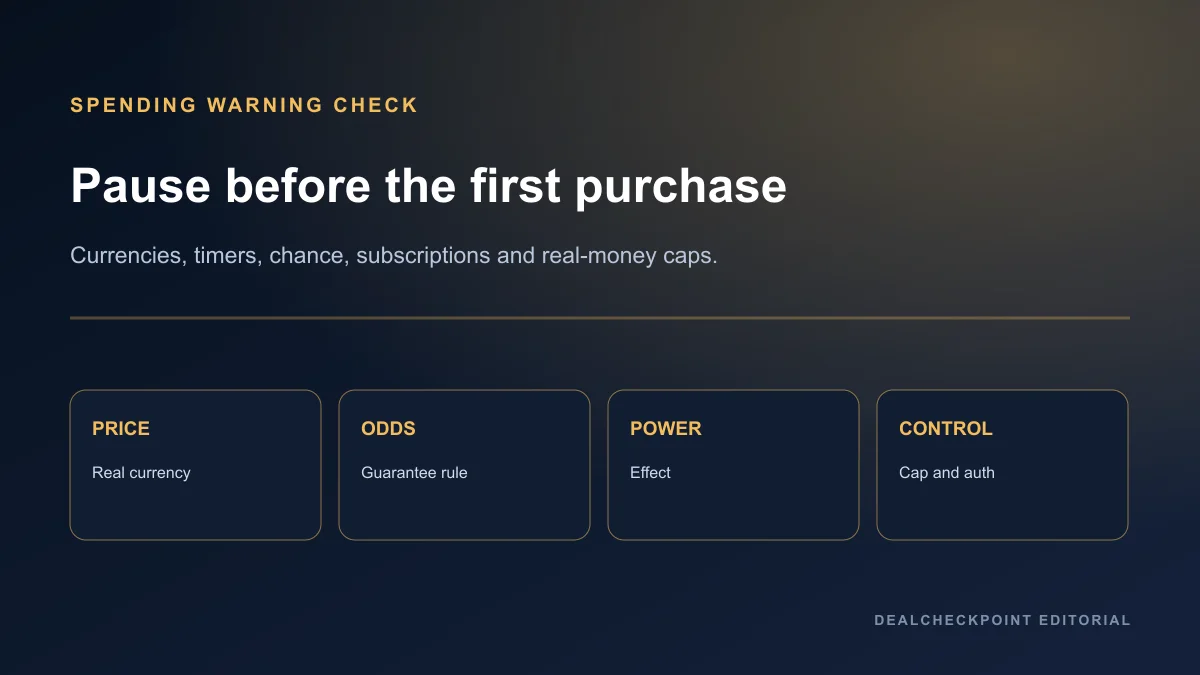
- Multiple premium currencies make the real-money price hard to calculate
- Power or progression items appear in rotating limited-time offers
- Duplicate characters or weapons increase stats
- Inventory pressure appears only after substantial time investment
- Ranked access, matchmaking pools or account rewards change after payment
- The game sells time skips before explaining the normal grind
- Published probabilities omit a clear guarantee rule
- Subscription benefits combine convenience, rewards and progression
- Trading creates pressure to speculate or use unofficial markets
A warning sign does not prove abuse. It tells you what to document before spending. Open the official shop, terms, probability disclosure, refund rules, and parental-control settings rather than relying on a creator’s summary.
Budget controls
Set a monthly cap in real currency, not premium currency. Convert every bundle to the amount charged, include tax, and count subscriptions separately. Do not treat currency left in an account as free money.
For randomized systems, decide the maximum spend before the first pull and assume you may receive no preferred result before the documented guarantee. Never borrow, chase a prior loss, or increase the cap because an event is ending.
Disable one-click purchasing where the platform allows it, require authentication, review purchase history, and remove stored payment methods from accounts used by children or shared households. A zero-dollar installation is not permission for an unlimited in-game budget.
Parent and younger-player considerations
Parents should check the game’s age rating, online communication, user-generated trading, random-item disclosures, account-linking requirements, and purchase authentication. The most important screen may be the platform account setting rather than the in-game store.
Discuss the difference between earned currency and paid currency, and explain that limited-time offers are designed to create urgency. Use a fixed allowance only when the child can see the real-money equivalent and understands that randomized outcomes are not guaranteed.
Steam Families provides parental controls and purchase-request tools for child accounts. Publisher launchers and consoles use separate controls, so verify the account that actually processes payment.
Frequently asked questions
Is cosmetic monetisation always harmless?
Not automatically. A cosmetic can create readability or age-appropriate-content concerns, and randomized cosmetics can create spending risk even without combat power.
Is pay-for-convenience the same as pay-to-win?
Not by this framework, but the boundary is subjective. Convenience can become strategically important when storage, analytics, roster access, or time savings affect preparation for the evaluated mode.
Does a gacha game automatically receive Level 4?
No. Gacha describes random acquisition. Genshin reaches Level 3 here because acquired characters and weapons affect PvE capability, while no direct ranked competitive-power scope is evaluated.
Can a game have more than one rating?
Yes. Counter-Strike skins are Level 0, its randomized cases add spending risk, and Prime-related account context is Level 1. The framework records systems and scope rather than stamping one permanent label on the entire game.
Where should I verify current purchases?
Use the official publisher shop, support documentation, probability disclosure, and platform product page. Live-service stores change, so recheck before spending.
Final framework
Identify the mode, list every purchasable effect, separate content from power, record randomness and guarantees, and decide whether saved time or expanded options violate your standard. Then apply the highest relevant level to that system and scope.
Level 0 presentation is not Level 4 competitive power, but neither is every free-to-play game cosmetic-only. The practical answer is evidence: what payment changes today, for the activity you care about, and at what real-money cost.