Information verified on August 4, 2026.
Quick verdict
Yes — Warframe is worth playing in 2026 if you want a free, fast third-person action game with deep build systems, cooperative PvE and years of content ahead. The official site at https://www.warframe.com/ describes a live game with ongoing updates, and the TennoCon 2026 recap announced Warframe: Tau and the Fall 2026 Iceblade of Narin update. The Steam store listing confirms the base client is free to install with optional in-game purchases.
The honest answer is not about price alone. Warframe rewards players who enjoy movement, collecting gear and learning systems over time. It is a weaker fit if you want a short story with a clear ending, simple menus on day one, or a competitive ladder as the main attraction. Start free through Warframe on DealCheckpoint, protect your early Platinum and decide after ten hours whether the core loop earns your time.
Is Warframe actually free?
The official store listing at https://store.steampowered.com/app/230410/Warframe/ lists Warframe as free to play with optional in-game purchases. The base client, story quests and blueprint-and-Foundry route are accessible without buying Platinum through official stores. Platinum remains optional for inventory slots, build rushes and cosmetics according to in-game and store documentation — not proof that every item is instantly earnable without time or limits.
| What the official materials describe | Free access | Paid or accelerated route | What that means for a 2026 newcomer |
|---|---|---|---|
| Base client and account | Free download on supported platforms | No entry fee on official stores | Install from an official source and verify regional availability |
| Story quests and Star Chart | Earned through normal progression | Some bundles can include items or cosmetics | Follow the early quest path before chasing side systems |
| Warframes and weapons | Blueprint, resource and Foundry route | Platinum can buy finished items or speed access on eligible listings | Learn crafting before treating Platinum as a shortcut |
| Mods and upgrades | Earned through missions and vendors | Store bundles may include Mods or cosmetics | Power comes from understanding builds, not from a single purchase |
| Inventory capacity | Starting slots plus earned capacity | Extra slots can be bought with Platinum | Capacity is a real long-term consideration, not a cosmetic detail |
Warframe is therefore free in the sense that no purchase is required to install and progress. It is not free in the sense that time, inventory limits and optional Platinum spending shape the experience. That distinction is central to whether the game is worth your calendar, not just your wallet.
What money buys
Platinum is Warframe's premium currency. Official documentation states it can be used to purchase weapons, Warframes, inventory slots, cosmetics, bundles and other store items. Some Platinum can be purchased directly; some can enter the player economy through trading on eligible accounts. Prime Access is a recurring premium track tied to Prime content cycles, offering exclusive items, Platinum and other benefits according to the current official Prime Access page.
| Purchase category | What official materials describe | Impact on gameplay access | Reasonable expectation |
|---|---|---|---|
| Platinum packs | Buy currency for the in-game market | Can accelerate item access or reduce waiting | Convenience, not a substitute for learning systems |
| Inventory slots | Expand Warframe, weapon and other capacity | Removes a common progression friction point | Useful once you understand what you want to keep |
| Cosmetics and bundles | Skins, color palettes, syandanas and themed packs | Mostly visual | Optional support unless a bundle includes gear you would craft anyway |
| Prime Access | Timed premium track with Prime rewards | Provides Prime gear and related items during the cycle | Compare value against how much you already play |
| Regal Aya and similar passes | Official store descriptions vary by season | Can include cosmetics or convenience items | Read the current listing before assuming permanent ownership |
Official materials do not describe Warframe as a cosmetic-only economy. Platinum can affect how quickly you obtain certain gear and how much inventory you maintain. Spending can make a game you already enjoy smoother. It cannot replace movement skill, Mod knowledge or mission familiarity. For a broader look at how free games monetize, see Are free-to-play games pay to win in 2026?.
Slots, crafting timers and Platinum
Inventory slots and Foundry timers are two of the most practical reasons players consider Platinum. Official documentation confirms that additional Warframe, weapon and companion slots can be purchased with Platinum. The Foundry turns blueprints and resources into equipment on timers that can sometimes be rushed with Platinum according to the in-game interface and support articles.
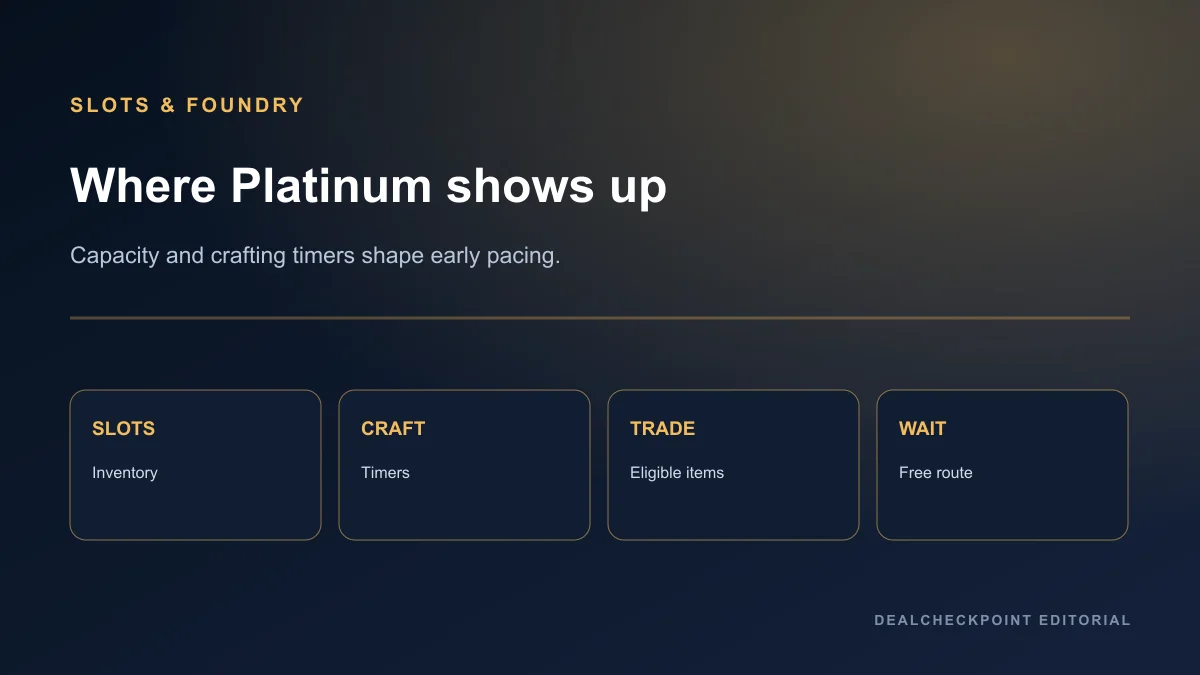
Starting accounts receive limited slot capacity. As you earn blueprints and craft gear, that capacity becomes a decision point: sell or discard equipment, pause new projects, earn Platinum through trading where eligible, or purchase slots. None of those choices is inherently wrong, but pretending slots never matter misrepresents the live game.
Crafting timers add another layer. A blueprint may require hours or days in the Foundry before an item is ready. Free players wait, plan parallel projects or farm other resources during downtime. Platinum can rush some timers. Official support describes this as optional acceleration, not proof that ordinary crafting is broken. If waiting ruins your session rhythm, that is a personal fit question worth answering before spending.
Player trading adds complexity. The official trading FAQ distinguishes purchased or traded Platinum from starting or promotional Platinum and requires account security measures for eligible trade activity. Trading can help free players obtain specific items or convert farmed goods into Platinum, but it also demands research, patience and adherence to official rules. Treat trading as an advanced system, not a day-one requirement.
Core gameplay loop
The official overview at https://www.warframe.com/ describes Warframe as a cooperative action game built around agile combat, customizable Warframes, hundreds of weapons and expansive destinations. The moment-to-moment loop is movement plus shooting or melee, ability use, loot collection and return to your Orbiter to install Mods, craft gear and choose the next mission.
Progression is horizontal as well as vertical. Mastery Rank rewards trying new equipment. The Star Chart opens planets and mission types. Quests unlock systems such as the Archwing, open zones and later story chapters. That breadth creates long-term value for collectors and build experimenters. It also means the game can feel overwhelming until you choose a near-term goal.
Mods are the hidden engine. Weapons and Warframes accept Mods that change damage, survivability, ability behavior and utility. Polarity, capacity and upgrade costs matter. Official in-game tutorials and the Codex explain basics, but mastery comes from play. A player who enjoys tinkering with loadouts will find enormous depth. A player who wants fixed optimal builds handed out immediately may feel friction.
New player experience
Warframe's new player experience has improved across years of updates, but official materials still describe a game with many interconnected systems. The opening quest introduces movement, combat and the Foundry. Junctions on the Star Chart gate advanced features until you complete specified objectives. That structure prevents everything from appearing at once, yet community advice and returning-player knowledge can make the early hours feel noisy.
The official quick-start guide recommends adjusting matchmaking, reviewing basic controls and following early quests before diving into open-world zones or trading hubs. That guidance aligns with a worth-it test: if the first missions feel good, the complexity ahead may be an asset. If menus, timers and unexplained icons dominate the fun, more content will not fix the mismatch.
Common early friction points include understanding mission objectives, knowing when to mod gear, resisting impulse Platinum spending and avoiding premature comparison to veteran players. Digital Extremes continues to adjust onboarding through patches and events, but no tutorial replaces the need to play several hours and form your own reaction to the pace.
Solo vs co-op
Warframe supports Solo, Friends Only, Invite Only and Public matchmaking according to the official quick-start guide. Many Star Chart missions, quests and open-world activities can be completed alone, especially when learning mechanics or reading dialogue. Solo play is a legitimate way to experience the game and is often the calmest route through early story content.
Public squads can speed repeated farming, carry newer players through familiar missions and make some boss encounters smoother. Cooperative play is also where Warframe's chaotic ability combinations shine. The trade-off is pace: experienced squads may finish objectives before a newcomer understands the route. Friends Only and clan groups offer a middle ground when you want cooperation without full random matchmaking.
For players deciding whether the game is worth time, try both modes in the first ten hours. Solo answers whether you enjoy movement, gunplay and mission clarity on your own. Public answers whether faster group clears feel helpful or disorienting. Warframe does not require a permanent group, but it rewards social play for certain farms and late-game activities.
Cross-play and account linking
Warframe's official cross-platform guide supports cross-play and linked progression across PC, PlayStation, Xbox, Nintendo Switch and supported mobile versions where available. Account linking is presented as a permanent choice with a primary account selection. Official documentation warns players to read confirmation screens carefully because combined accounts cannot be unlinked casually.
Cross-platform trading has eligibility rules, including two-factor authentication requirements described in official support articles. Not every Platinum type behaves the same in trading, and not every item is tradable. Before linking accounts or moving platforms, read the current cross-platform guide and trading FAQ rather than third-party summaries.
Cross-play matters for worth-it calculations when your friend group spans platforms or when you want one long-term account across devices. It does not remove regional, input or performance differences. Verify that your preferred platform meets the official system requirements and that store purchases follow the correct account.
Grind and time investment
Warframe is designed for repeat missions, resource farming, blueprint collection and long craft queues. Official Steam and warframe.com materials describe blueprint-and-Foundry progression as the primary free route, with optional Platinum for slots, rushes and cosmetics. Some players enjoy optimizing farms and rotating goals. Others experience the same loops as chores.
| Activity type | Typical time shape | Free route | Where Platinum or trading appears |
|---|---|---|---|
| Early Star Chart | Short missions with clear rewards | Repeat for resources and Mastery | Optional rush timers or buy finished items later |
| Blueprint farming | Targeted missions or relic openings | Repeat until parts drop | Market purchases or trades for specific parts |
| Foundry crafting | Real-time timers after resource collection | Wait or parallelize projects | Rush with Platinum on eligible items |
| Mod and resource upgrades | Ongoing throughout account life | Farm and purchase from vendors | Some bundles include Mods or boosters |
| Open-world and late-game systems | Longer sessions and broader gear checks | Progress through quests and Mastery | Cosmetics and convenience items in store rotations |
Grind intensity varies by goal. Completing the main story path differs from chasing every Prime set, max-rank Mods or high-level Steel Path content. The TennoCon 2026 recap shows the game still expanding, which adds opportunity for dedicated players and pressure for newcomers who feel they must catch up. A healthier framing is personal milestone setting rather than total completion.
If your available play time is short and irregular, Warframe can still be worth it for story sessions and occasional build experiments. If you dislike repeating missions for parts or waiting on timers, the same systems will feel heavier over months.
Endgame and long-term value
Warframe's endgame is not a single raid tier. It includes Steel Path difficulty, high-level Mod farming, open-world reputation, faction systems, seasonal events, Prime rotations and ongoing story chapters. The TennoCon 2026 recap announced Warframe: Tau for later in 2026 and Iceblade of Narin as the Fall 2026 update, alongside additional Warframes, reworks and Prime content. That public roadmap indicates active development rather than maintenance mode.
Long-term value depends on whether you enjoy mastery-style progression. Mastery Rank encourages trying new gear. Build variety keeps older content relevant when a new Mod or Warframe changes synergies. Seasonal events and Prime Access cycles add timed goals. Players who want a definitive ending may never feel finished. Players who treat the game as a hobby often consider that a feature.
Official news posts through mid-2026 continued after TennoCon, which supports the case that matchmaking, events and new systems remain part of the live schedule. Activity can still vary by platform, region and mission type, so check current official announcements for specific events rather than assuming every old node stays equally populated.
Who should play
Warframe is worth trying in 2026 if you enjoy fast third-person combat with parkour movement, cooperative PvE, collecting Warframes and weapons, experimenting with Mod builds and returning to a game across months or years. It suits patient learners who do not mind reading systems and players who can set personal goals instead of chasing the entire checklist at once.
It also fits groups that want cross-platform co-op after careful account linking, and players who appreciate a free entry with no mandatory subscription. If you already like looter-style progression but want sci-fi mobility instead of cover shooting, Warframe offers a distinct feel within the broader genre discussed in the best free co-op games guide.
Who should skip
Skip or defer Warframe if you want a compact campaign with a clear end credits moment, dislike crafting timers and inventory management, feel overwhelmed by dense upgrade menus or prefer competitive PvP as the primary draw. That profile is not a fit for Warframe's long-horizon cooperative loop.
Players who need immediate clarity from every system may bounce off before the fun starts. Veterans of other looters should not assume Warframe plays like a first-person shared-world shooter; its mission structure, Mod math and Orbiter workflow are their own ecosystem. If after ten hours the core combat still feels awkward, additional content is unlikely to reverse that reaction.
First ten-hour plan
Use the first ten hours as a structured worth-it test rather than a race to endgame. Official guidance supports learning movement, completing early quests, opening initial Star Chart nodes and using the Foundry before engaging trading, open-world economies or large Platinum purchases.
| Hour block | Focus | Good signal | Warning sign |
|---|---|---|---|
| Hours 0-2 | Opening quest, movement and first mods | Sliding, jumping and combat feel satisfying | Camera, speed or UI remain uncomfortable after adjustments |
| Hours 2-4 | Star Chart nodes and Foundry crafting | Missions have readable objectives | Every objective feels confusing even at slow pace |
| Hours 4-6 | Install and upgrade basic Mods | Small changes improve performance | Menu depth removes the fun |
| Hours 6-8 | Try Solo and one Public mission | Both modes offer something useful | Public pace feels punishing every time |
| Hours 8-10 | Pick one near-term quest or gear goal | You want to return tomorrow | You are only thinking about what to buy with Platinum |
During this window, avoid deleting crafted gear before understanding Mastery, spending starting Platinum on cosmetics, or copying endgame build guides that assume rare Mods. Note inventory pressure honestly. If you are already enjoying the loop but short on slots, that is information — not a failure. Decide whether earning or buying capacity fits your budget and patience.
After ten hours, ask three questions: Do you enjoy movement and combat? Do missions feel understandable enough to repeat? Do build upgrades create curiosity rather than dread? Three yes answers suggest Warframe is worth continuing. One or more no answers suggest trying an alternative before investing months.
Alternatives
Warframe occupies a specific niche: free, sci-fi, mobility-heavy cooperative loot progression. If that niche is not yours, compare other options before committing storage and attention.
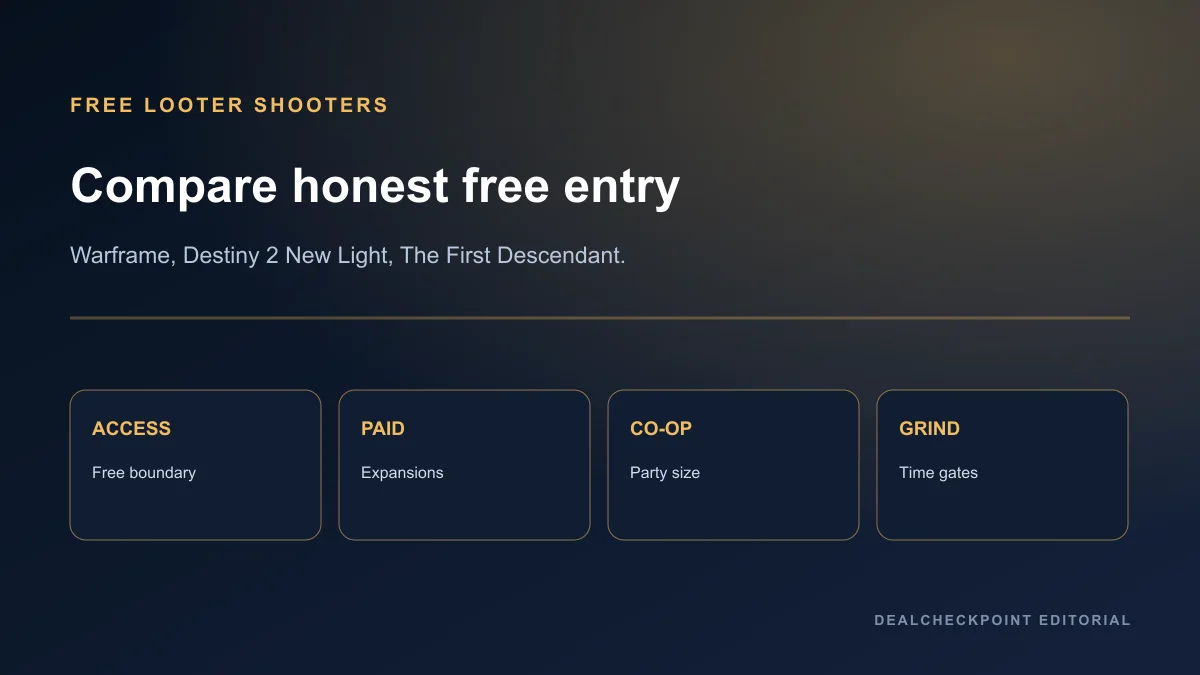
Destiny 2 offers first-person shared-world shooting with a different free-access boundary and seasonal model. The First Descendant provides third-person looter-shooter combat with its own monetization and update schedule. For a wider genre survey without repeating a full three-game comparison here, read the best free looter shooters in 2026 pillar and return to this page for Warframe-specific fit questions.
If cooperative play matters more than loot depth, the best free co-op games in 2026 guide covers lighter session games and different progression styles. None of these alternatives removes Warframe's unique movement or Foundry workflow, which is exactly why a direct worth-it decision should be personal rather than generic.
FAQ
Is Warframe worth starting in 2026?
Official TennoCon 2026 materials show active development toward Warframe: Tau and a Fall 2026 update, which supports starting now if the core loop appeals to you. Worth it does not mean catching up with every veteran system. It means the free opening hours justify continued play on your schedule.
Is Warframe really free to play?
The Steam store listing and official site describe a free client with optional purchases. Blueprint-and-Foundry progression is the primary free route; Platinum buys slots, rushes and cosmetics rather than a mandatory entry fee.
Do you need to spend Platinum?
Official documentation describes Platinum as optional for accelerating access, buying slots and obtaining certain store items. Many accounts progress without regular spending, but stating that Platinum is never useful would contradict official store design. Treat it as a convenience currency you can earn partially through trading on eligible accounts or buy directly.
Is Warframe pay to win?
Warframe is primarily cooperative PvE rather than a ranked competitive shooter. Platinum can shorten waits and expand inventory, which affects convenience and acquisition speed. It does not replace player skill, Mod knowledge or mission understanding. For a broader framework, see Are free-to-play games pay to win in 2026?.
Can Warframe be played solo?
Yes. Official matchmaking settings include Solo mode, and many early missions and quests are viable alone. Public squads remain optional for faster farms and social play.
Does Warframe have cross-play in 2026?
The official cross-platform guide describes supported cross-play and linked progression across listed platforms after account linking. Read the current guide before linking because the process is permanent and includes primary account selection.
How long does Warframe take to get good?
There is no official finish line. Basic mission competence can arrive within hours, while deep build mastery spans months. The worth-it question is whether early competence feels fun, not whether you reach endgame by a deadline.
Is Prime Access necessary?
No. Prime Access is an optional premium track tied to Prime content cycles. Prime gear can also be farmed or traded according to official acquisition routes. Compare the current Prime Access listing against how much you already play before subscribing.
Final verdict
Warframe is worth playing in 2026 for players who want a free, deep cooperative action game with exceptional movement and long-term build variety. Official sources confirm free installation, optional Platinum monetization, cross-platform support and an active update roadmap that includes TennoCon 2026 announcements. The game asks for time, system literacy and honest inventory planning more than it asks for an upfront price.
Start through Warframe on DealCheckpoint, play ten focused hours, protect early Platinum and judge the combat loop before chasing every open-world system. Continue if movement, missions and Mod upgrades pull you back. Skip if timers, menus or repetition feel heavier than the fun. That verdict costs nothing to test and is more reliable than any generic score.